A CLOUD OF QUILT PATTERNS: AN ENCYCLOPEDIA OF PATTERN IN BLOG FORM UPDATES & ADDITIONS BY BARBARA BRACKMAN

Monday, July 10, 2017

Oak Leaf & Cherries: Dots, Dots, Dots


#14.86 in my Encyclopedia of Applique.
My source for the pattern was this quilt pictured in the Texas Quilts, Texas Treasures book from 1986.

Oak Leaf & Cherries, 1890-1900 by Mrs. Dillingham,
Ardmore, Oklahoma

 I was glad to find a second example in the files of the
North Carolina project.

Quilt by Lena Applewhite Thompson
Wilson County, North Carolina.
Last quarter of the 19th century.

Here's a variation, the symmetry based on 8
rotating arms with dots. 

From a dotty sampler pictured in Woodard & Greenstein's Crib Quilts

The caption says Chester County, Pennsylvania.

Then I found this spread on the Cumberland County, Pennsylvania book on quilts seen
in the Letort Quilters Documentation Project.
.
The documenters saw several examples. They call it Flowers & Bubbles.

A regional favorite. Notice the dots are arranged in threes.

Variations from various places:

A simpler version from 1880-1910.

From an online auction.
Note the checkerboard cornerstone is the same
as the earlier North Carolina quilt.

And if you liked making dots, you could make 12
as in this sampler quilt from the collection of the Briscoe
Center for American History, University of Texas at Austin.
Another quilt from the Texas project.

From an online auction years ago.
Fill up those empty corners with more dots and a few stars.

Print this out 8 inches square
and double it for a pattern for an 18-22" block.

Monday, July 3, 2017

Pineapple ala Carmen Miranda

I found this pineapple on Tim Latimer's blog.
He bought it on eBay.
It has an Encyclopedia of Applique number
46.46.


I saw a similar pattern in the 1978 Quilt Engagement Calendar,
probably this one that is now in the collection of the New England Quilt Museum.

Quirky as the design is with its reverse appliqued fruit,
I've got several photos of similar quilts.

The whole thing has a Carmen-Miranda look.


International Quilt Study Center and Museum
1997.02.082

The one below was documented by the North Carolina Project.

Rowan County, North Carolina

Judy Roche owns this 20th-century block. Dots
instead of slashes in the fruit.

And I found this one on a Pinterest page;
I think it's in Teddy McMahon Pruett's collection.
No reverse applique, no dots.

Tim was inspired to make a copy by the example at the top of the page

He added texture to the fruit with quilting rather than
reverse applique.
Amazing quilting.

See more pineapple patterns here:
http://barbarabrackman.blogspot.com/2016/08/digital-encyclopedia-of-applique-no.html

Monday, June 26, 2017

Cross Roads

It's hard to see the repeat here.

This is the block.

It's BlockBase #2946

The first publication was by Clara Stone about 1910, who called it
Cross Roads to Bachelor's Hall, 
but she ran a fairly obscure New England pattern company.


The Kansas City Star made it popular by publishing it three
times at least---first under the name Cross Roads in the '30s
Then as Wagon Wheels in the '40s
And also as Broken Circle in the '50s.

Many of the 1930s quilts were probably made
from Eveline Foland's Star pattern about 1930.


The basic design is older than the published patterns.
The Tennessee project found this dramatic red and green version.

Made by an unknown woman about 1890 in Winchester, Tennessee.


A variation with more pieces, again from Quilts of Tennessee.
Made by Eliza Hensley Johnson,1875-1900.

The gray colored shapes are the extra pieces


Online auction. 1890-1920?


You can make a Quick Quilt in BlockBase to show how
the block repeats. The secondary designs certainly offer
a lot of design potential.

A scrappy thirties look

There's also a variation numbered 2947.

Pattern designer Hubert Ver Mehren added an extra square in the arc in the mid-1930s(although it's really not square.) He may have noticed the Star version and decided to change it a little.

An ad for his Colonial Quilt Book

An impressive version of #2947 Cross Roads
from the New England Quilt Museum's collection.

One difference between these patterns is the proportion of
arc to the squeezed, curved, 4-sided shape (gray here).
Ver Mehren showed the squeezed shape as rather wide.

Foland's version also shows it as wide at the point,
but in some it's quite narrow, finishing in a sharp point.

Monday, June 19, 2017

Carol's Scrap Time Quilt #2404

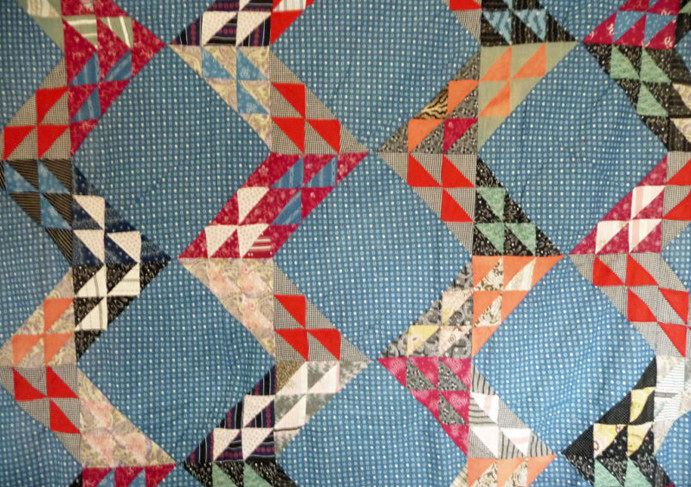
An interesting top from about 1880
The block is not what it first looks to be


It's a square inside a square.
BlockBase #2404,
which was first published (according to me) as Carol's Scrap Time Quilt
in a pattern magazine in 1964.
It must have been published before that.

Here's a variation
that looks last half of the 19th century.
#2404.3

A 2404 block from about 1910

Set at a half drop  (each strip is dropped a half a block),
which gives you a whole different look.


1880s


And here's another from about 1880---maybe a little earlier. 
Half drop repeat.
Less color organization in the corners.

BlockBase will draw you any pattern any size.
I did it for you.
#2404 as a 12" block.
You need 1 square cut 9"
And 36 half-square triangles cut from 18 squares cut 2-7/8"