A CLOUD OF QUILT PATTERNS: AN ENCYCLOPEDIA OF PATTERN IN BLOG FORM UPDATES & ADDITIONS BY BARBARA BRACKMAN

Monday, September 4, 2017

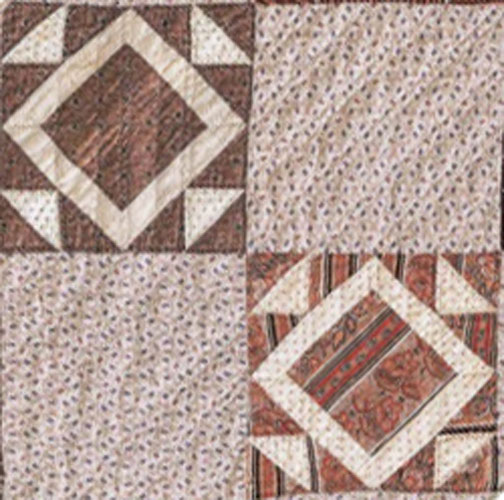
Square in a Square Blocks

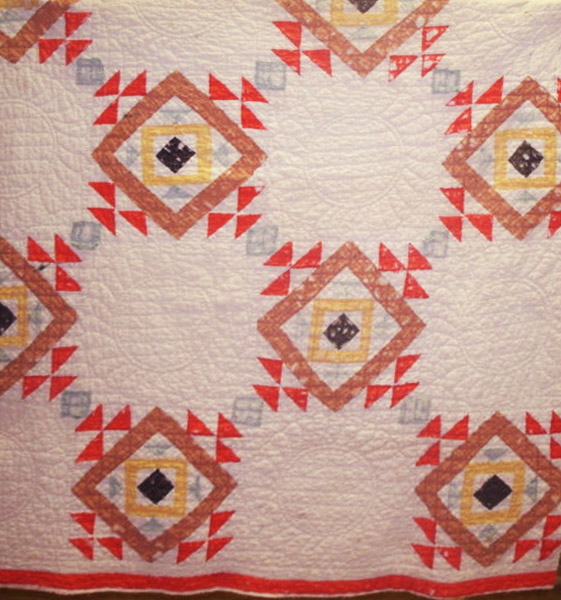
A quilt from about 1880 shown in Roberta Horton's book Scrap Quilts

BlockBase #2470

The pattern's been published several times with the uninspired name of
Mosaic---perhaps derived from a floor tile. 


A slightly different proportion, a different number:
"The Road to Paris"
It wasn't a popular design.


But add more pieces to the center:

And it's easier to find examples made about 1900.
Earliest name is probably Jack in the Pulpit from Clara Stone
or Double Squares from the Ladies Art Company.

1880-1900


Different proportion, different number
This one was named The Dewey for Admiral George Dewey
who defeated the Philippine navy in 1898.

Dewey was so popular that BlockBase has
5 patterns named for him.
But we've forgotten him---so much for cultural memory.
Most of us would
call the pattern Jack in the Pulpit

Pattern from Clara Stone catalog,
1906.
I found this picture at the Quilt Index, which also 
included the copy:
"May be in two or three colors, as one happens to have the pieces. It is a nice pattern for an album quilt, writing name, town, county and State in the white half-squares surrounding the center block. It is prettiest all of pieced work, but may be set with plain squares of white or light goods, with strips, or in diagonal sash-work. C. A. S. Holliston, Mass."

A signature version. I bet they got the pattern from C.A.Stone.


Mary E. Beardslee Durkee, about 1870. Collection of the 
Museum at Michigan State University. # 1999:12.6

http://museum.msu.edu/museum/tes/quiltsoldnew/Exhibit%205.htm

In BlockBase you can right-click on the block and
choose Quick Quilt. The program shows you
how it would look set all over.

Mid-20th century


Monday, August 28, 2017

An Alabama Pattern

Quilt by Cyatus Fowler
20th-century
Birmingham Museum of Art
Cargo Collection of Alabama Quilts

Cyatus's pattern is unknown and unusual but such smart geometry that I'm surprised I had no other examples.
Strips of squares
Strips of diamonds.

I drew it in EQ7 by making a grid of squares
and then drawing diagonals in the alternate blocks.
I erased some lines in the diamond strips


EQ sez:
The squares (A) are cut 6-1/2"
The diamonds (C) are cut from 4-3/4" strips at 45 degree angles.
Each diamond should be 9-1/4" long on it's long side.
They are really not diamonds by parallelograms, but what the heck.
B is triangles for the edges of the diamond strips.
Squares cut 6-7/8" and then cut into triangles with a single diagonal cut.


Perhaps we should call it Alabama Roads.

Here are some similar ideas but these alternate rectangles and diamonds.

Kitty Corner from Keepsake Quilting.

Here's the closest I could come in the 19th century. And it's not very close.

Last quarter 19th-century.
Susan Dague's collection. Quilted later.

Last quarter, silks.

Monday, August 21, 2017

Mrs. Cleveland's Choice


Mrs. Cleveland's Choice
BlockBase #2481

Here's a complex design that's a late-19th-century pattern
designed by a commercial source with a reference to current events.

 
The Ladies Art Company published the block as
Mrs. Cleveland's Choice. Perhaps someone asked
Frances Folsom Cleveland, wife of President Grover
Cleveland for her opinion.

 In 1886 21 year old Frances Folsom
married the President who was 49.


 As a First Lady in her twenties, Mrs. Cleveland was a fashionable celebrity. The patchwork pattern named for her inspired numerous quilts.


Setting the blocks side-by-side creates a different look.

Here it is in a BlockBase Quick Quilt.

Which you could view as two alternate blocks.
A combination of a Jack-in-the-Pulpit and a block of triangles.


The Quilt Index shows the triangle quilt below documented by the Massachusetts
project that is signed Mrs. Grover Cleveland.

So this might actually be Mrs. Cleveland's Choice.

http://www.quiltindex.org/fulldisplay.php?kid=1D-FC-B52

Monday, August 14, 2017

Star of the Bluegrass

Source? 
Quilt of chrome orange and blues
with sashing that may have faded to gray-brown,
late 19th century.

Stars pieced of diamonds seem among the most common of quilts.


But I'm surprised to find this particular arrangement is rather uncommon:
Four diamonds in each star point.
BlockBase #3772


I'm not short of published names.

Patriotic Star from the Kansas City Star in 1936.

But 19th-century examples are rare.

Here's a quilt dated 1842, the earliest example I have
of a star with four diamonds per point.

Thia one from Stella Rubin's shop. It could be about the same time,
about 1840.


The quilt at the top of the page looks to be late-19th century.

Blocks may be about 1900 when grays and blues popular,
set with more colorful sashing later.

Most are 20th century...

From Cindy's Antique Quilts

It seems to be a useful pattern with lots
of shading possibilities.

Most quilts in the design date to later than 1933

When a quilt from Kentucky won national attention at the 
Worlds Fair Quilt Contest sponsored by Sears.

Mountain Mist published the prizewinner
with its fashionable green color scheme and stuffed work quilting. 


They called it "Star of the Bluegrass" for Kentucky. Many seamstresses were inspired to make copies by their pattern (published in 1948). Right after the Fair Sears published a pamphlet about the contest containing an ad for a kit for the Star of the Bluegrass. Times were tough, but people bought the kit.

Found in the Wisconsin project, purchased at an
estate sale.

Elizabeth Nesbett Cooper, Crawfordsville, Indiana
Indiana Project

The family story is that Elizabeth ran out of that green fabric
so substituted black.

Mary (Marija) Soklic Bartol, Cicero, Illinois About 1933.

This one from the Quilt Index also has a story:
"1933 was a difficult year, the worst year of the Great Depression. Work, and therefore income, was irregular, so my family's entertainment was making quilts. And since fabric cost money, most of our quilts were scrap quilts. That year, I visited the Chicago World's Fair with my parents. Because we were quilters, we were especially impressed with the display of prize-winning quilts at the fair. My father took the time to copy the pattern of a quilt that he admired, and later he made cardboard templates that my mother used to piece the quilt. My father even helped with the quilting. To the best of my memory, that quilt was green with very pretty printed fabrics. Our family made many quilts together."

See a PDF from the University of Chicago with the Sears pamphlet featuring an ad for a kit. 
Read more about the contest and the quilt copies here:


Stars with 9 diamonds in the points were far more
common in the 19th century This one is dated 1845.

Dated 1868

Mid-19th century.
There's something for you to ponder.
Why 9 patches instead of 4 patches?
Well, don't ponder it too hard. We don't have an answer.