A CLOUD OF QUILT PATTERNS: AN ENCYCLOPEDIA OF PATTERN IN BLOG FORM UPDATES & ADDITIONS BY BARBARA BRACKMAN

Monday, January 18, 2021

Mystery Dot


National Polka Dot day is Friday, January 22
so I looked through my polka dot file to find this rather odd dot quilt
from eBay maybe six years ago.

What is going on here---repeat wise?

I squared it up and it is still rather mysterious
Circles, squares and rectangles...

from 1935-1960?

There is a square block here:

And once you figure out where the seams are it's a pretty basic repeat.


The actual block does not have a round dot but an octagon in the center. Couldn't find it in my
Encyclopedia of  Pieced Patterns or BlockBase...

in the 358x area---Stars with
octagons in the centers.

I exported one from BlockBase to EQ8 to draw a patten and changed a few lines. That red and white drawing above would give you an 8" pattern. The square in the corner would be cut 2-5/8".

A good way to piece a dot into a square.

Minimalism

The set makes it unusual.

If the square is cut 2-5/8" then the sash should be cut 2-5/8".
Those strips alternate red and white.


Well that's probably enough time spent on that repeat.
The idea of alternating colors in the setting strips is interesting
but this one doesn't really work too well.

Monday, January 11, 2021

Brown Goose/Gray Goose


Looks like a Pennsylvania quilt---
color on color with no neutral,
pink, green and blue.

The pattern is a three-patch
one of the smaller categories in my Encyclopedia of Pieced Quilt Patterns.

This may be the same quilt---different exposure
or after washing and fading.

The block could be constructed as a Nine Patch
but no, there was a fashion for this three-patch.
Fewer seams, but Y seams.
Y?

#3220 in the Encyclopedia of Pieced Quilt Patterns

Which tells us the oldest published version is about 1900
in the Clara Stone booklet called Old Maid's Puzzle #2.

Ruth Finley in her 1929 gave it several names, Gray Goose, Brown Goose (depending on the color)
Devil's Claws and Double Z.

A few years later the Nancy Cabot column in
the Chicago Tribune called it Old Gray Goose

This example---a Brown Goose, I assume---
is from Julie Silber's inventory. 
Date: Perhaps 1880-1900


The Quilt Index shows a few that seem to pre-date the Clara Stone pattern.

Some of the fabrics in the blocks look pre Civil-War
in this one the New Jersey project recorded as
originating in a boarding house in Atlantic Highlands
run by Mary Crane Noble.

Unknown origins from the Massachusetts project
and the Quilt Index.

UPDATE:


Laura Lane sent this one from the collection of the New England Quilt Museum.
The center features a U.S. Grant Presidential campaign bandana (ca. 1868.)

Monday, January 4, 2021

Oklahoma Rainbows and Snakes


Quilt from the 1950-1970 years by Lillie Justus Story of
Valliant, Oklahoma.
 Buckboard Quilts in Oklahoma City 

I included this pattern in the 3rd edition of the Encyclopedia using Lillie's quilt as an example. (#1505.5) The design has many cousins but I could not find a published version with the double arcs making a ring.

Buy this quilt from Judy Howard at Oklahoma City's buckboard Antiques

Bonnie over at the QuiltHistorySouth Facebook group found one published in Better Homes and Gardens's book Grandma’s Best Blocks from 2002.


 But there has to be an earlier source. 

Variations on this design have been driving me crazy. How to classify them?  I realize now what the problem is. 

#3350 & Relatives

I've been looking in the wrong place---four patches.  Here is where to find the pattern and its sources in BlockBase (and the Encyclopedia of Pieced Quilt Patterns.) I saw this (40 years ago) as a double fan,
a rather obscure category. The block is usually published in this single repeat but Lillie above turned that repeat into a four-patch.


The Rainbow Quilt (Date?)

As you can see in the Encyclopedia the Kansas City Star
published this pattern at least three times.

Drunkard's Trail in 1942
"This wavering design comes from [Arkansas reader]."
Pattern tells you to piece most of it in strings.
And people did.

From Julie Silber's Inventory, looks 1940s-50s

Spearheads & Quarter Circles, Kansas City Star, June 1956
Don't have a photo of this clipping.

The Star did not tell you to set it as a four-patch to make circles. And many people set it side by side.
Many people in Oklahoma.

Like a woman with the wonderful name of Arizona Sullivan,
according to the label on an Oklahoma quilt top sold on EBay a few years ago.

Closeups look like she used feedsacks for her backgrounds.

 The Star, published in Missouri, had a subsidiary newspaper focused on agriculture, the Weekly Star Farmer with an Oklahoma edition and that seems to be the link that connects these quilts.

From Northeast Oklahoma on an online auction

So in your new copy of the Encyclopedia go to #505.5 on page 176 and write in:
See #3350.
And on page 362 under #3350 write: See #1505.5.

See more confusion at these posts:

Monday, December 28, 2020

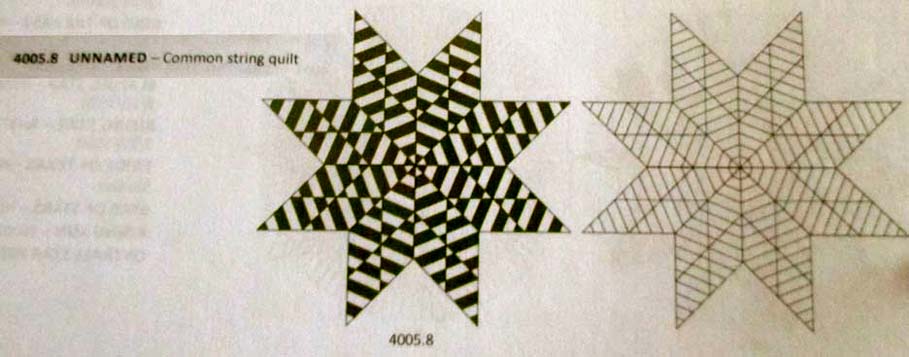
String Pieced Lone Star


Polyester String Quilt

I don't know if a pattern has ever been published for this whole top design
 of string-pieced diamonds. But it's a pattern you often come across.

It's one of the new numbers in the third edition of the Encyclopedia of Pieced Quilt Patterns.
I sent the drafters this sketch.


4005.8
Unnamed
Source: Common String Quilt

In this edition I added many designs that are common
but do not (yet) have a published source.

Here's their fix from the page proofs.


Amelia Etta Atkins (1879-1965)
from the Tennessee project & the Quilt Index

Most of these are from online auctions.

 Bertha Virginia Riddick from
the Michigan project & the Quilt Index.

Does it have a name?

Variation, not indexed.

Monday, December 21, 2020

Squares in a Triangle


Jane posted this mid-20th-century quilt top in the Facebook group
  Quilts:Vintage & Antique looking for a pattern name.
We were no help.
I did find relatives, however.

The theme is squares in a half-square triangle.
Classified as a two patch with a diagonal seam down the center of the block.
Jane's has six squares.
I found quite a range of dates on the idea, but no published patterns.

1860-1880? top
Three squares

1870-1890?
One square


15 Squares in some prints that look to be about 1910


Same time but 6 squares


10 squares from the mid-20th century
maybe 1960-1980?

Monday, December 14, 2020

Conventional Lily

Quilt from the Kuska Collection at the Thomas County, Kansas
Historical Museum


Hard to date.
Close fancy quilting, post-1880s greens fading to khaki or dun color.


From my Encyclopedia of Applique

Could it be as late as 1928 when Comfort magazine
published a pattern?


Comfort was quite influential in maintaining a small
and rather regional fashion for red and green appliques
into the 20th century.

If it's so "Conventional" how come these are the only two references to the pattern I can find?